
Summary: For post-PMF scale-ups that need senior guidance tied to practical delivery, Shadow Leaders is the strongest fit in this shortlist. TechCXO, Cerius Executives, and Chief Outsiders suit broader executive, interim, or go-to-market needs, while Connectd and matching platforms help you source specialist leaders. Compare who owns execution, how much time you need, and what a monthly engagement costs.
A growth bottleneck can call for a senior operator, a specialist match, or an advisor who also helps deliver the work. Our fractional growth leader vs. full-time VP of Growth comparison can help you decide whether the immediate gap calls for a fractional role. The best fractional leadership firms in 2026 are the ones whose working model fits your challenge, not simply the provider with the largest roster.
A fractional leader needs clear priorities, access to the right people, and a defined place in your decision-making. Harvard Business Review’s discussion of fractional leadership stresses the importance of involving part-time executives in key leadership touchpoints. That matters at a scale-up, where advice without authority or follow-through can leave the founder carrying the same bottleneck.
9 fractional leadership firms at a glance
Our top choice is Shadow Leaders for post-PMF founders who want senior guidance alongside practical implementation. The other firms serve different needs, including broad C-suite support, interim coverage, executive matching, or sales-specific leadership.
| Rank | Firm | Leadership model | Scope or fit | Pricing signal |
|---|---|---|---|---|
| 1 | Shadow Leaders | Tailored fractional leadership and advisory | Growth strategy, cross-functional guidance, and implementation | €3,500 to €15,000 per advisor per month on average |
| 2 | TechCXO | Fractional executive firm | Multiple C-suite functions, including technology, finance, operations, and growth | Confirm the fee and scope for your engagement |
| 3 | Cerius Executives | Executive network and placement service | Fractional, interim, or direct-hire leadership across functions | Confirm the fee and engagement terms |
| 4 | Chief Outsiders | Fractional executive firm | Marketing, sales, and go-to-market leadership | Custom engagement |
| 5 | Connectd | Matching platform for advisors and fractional leaders | Startup access to expertise across multiple functions | Confirm buyer-side pricing |
| 6 | Go Fractional | Recruiter-supported matching platform | Fractional and interim leaders across business functions | Personalized pricing |
| 7 | Fractional Jobs | Curated search with direct hiring | Fractional executives across business functions | Confirm current fees and terms |
| 8 | Toptal | Broad independent-talent network | Flexible access to specialists and business talent | Confirm terms for the specific engagement |
| 9 | Vendux | Curated sales-leadership matching | Fractional, interim, or project-based sales leadership | Request an engagement-specific quote |
How to compare fractional leadership firms
Start with the work, not the executive title. List the decisions, priorities, and deliverables you need owned, then decide whether you need a leader to advise, operate, or do both. A broad talent marketplace can widen your options, while a managed firm may shape the engagement around your company’s priorities.
Check decision rights, expected hours, meeting access, and who handles implementation. The Society for Human Resource Management describes fractional executives as part-time or contractual leaders who work with multiple companies. That arrangement makes clear responsibilities and communication especially important. Its overview of fractional leadership also notes that companies use these leaders to address specific challenges and goals.
Stage fit matters, too. Lightcast’s analysis of 2026 job-posting data found that small and medium-sized companies accounted for 97% of fractional job postings. Its fractional labor-market analysis supports the model’s relevance to smaller companies, but your own scope should still determine the provider you choose.
Finally, compare the person assigned, not just the firm’s network. Ask for their experience with your stage and business model, a written scope, and the fee for the time commitment you need. If you’re considering an advisor-led service alongside a hands-on firm, our Shadow Leaders vs Connectd comparison looks at the distinction. For a marketing-specific shortlist, see our best fractional CMO companies.
Detailed reviews of the 9 firms
1. Shadow Leaders
Best for: Founders and CEOs of post-PMF ventures, scale-ups, and fast-growing startups seeking senior guidance connected to practical growth work.
We combine strategic board-level advice with tailored fractional leadership and hands-on implementation. Our work can address go-to-market strategy, sales execution, fundraising, market entry, digital strategy, and strategic partnerships. You can access board advisors for up to 8 hours per week or fractional leaders for up to 32 hours per week, depending on the engagement.
Our private collective includes more than 40 experts. Our advisors bring more than 20 years of experience each, and our network has worked with more than 200 scale-ups and fast-growing startups. A customer testimonial describes support with expansion from India into the United States and several European markets, including enterprise projects and strategic partnership work.
Our average engagement range is €3,500 to €15,000 per advisor per month, depending on the selected advisor and hours. That makes it easier to weigh an engagement against its expected scope before committing.
Pros
- Hands-on implementation is available alongside leadership advice, so growth priorities need not stop at recommendations.
- The private collective can add perspectives beyond a single executive when challenges span sales, marketing, finance, or market entry.
- The stated monthly range and time options give you a concrete starting point for scoping an engagement.
Cons
- The stated engagement range represents a meaningful monthly investment, so it may not fit a company seeking only occasional, one-off input.
- Our stated audience is post-PMF ventures, scale-ups, and fast-growing startups, not businesses still validating product-market fit.
2. TechCXO

Best for: Growth-stage or established companies seeking a fractional executive across more than one C-suite function.
TechCXO provides fractional leadership across functions including finance, technology, operations, marketing, and sales. Its firm model suits companies that want an executive working with their leadership team rather than a self-serve directory of candidates.
The breadth can be useful when a business needs more than one kind of senior expertise as it grows. Before you engage, clarify who will lead the work, how much time they will commit, and whether the scope includes implementation or focuses on executive leadership and advice.
Pros
- Its range of executive functions suits companies with leadership needs across several departments.
- A firm-led model can help if you want support finding a suitable operator rather than sourcing independently.
Cons
- Its broad scope means you should confirm the assigned leader’s experience with your specific stage and growth challenge.
- Clarify the exact hours, responsibilities, and implementation expectations before comparing a proposal with other providers.
3. Cerius Executives
Best for: Companies weighing ongoing fractional support against interim leadership or a direct executive hire.
Cerius offers executives on an interim, part-time or fractional, and direct-hire basis. Its network covers multiple management disciplines, giving companies a route to consider different engagement types through one provider.
That flexibility is useful when the leadership need is changing or you are unsure whether a temporary vacancy requires an interim executive or a continuing part-time leader. Cerius states that executives can be onboarded within a week, so ask how that timeline applies to the role and candidate you need.
Pros
- Fractional, interim, and direct-hire options allow you to consider different solutions to a leadership gap.
- The provider describes a network of experienced executives across management disciplines.
Cons
- Because the firm supports several engagement types, specify whether you need a continuing fractional leader or temporary full-time coverage.
- Confirm the assigned executive’s availability, time commitment, and fee for your particular scope.
4. Chief Outsiders

Best for: Mid-market or growth-stage companies focused on marketing, sales, or broader go-to-market leadership.
Chief Outsiders specializes in fractional marketing and sales executives, including CMO and sales leadership roles. Its focus can suit a company that wants senior commercial direction and is ready to define the work around a specific growth challenge.
Before signing, ask which executive would work with you and whether the proposed scope includes only leadership or also execution resources. For a finance, technology, or operations role, compare it with a provider whose core scope covers that function.
Pros
- Its marketing and sales focus aligns with businesses seeking senior go-to-market leadership.
- The specialized scope makes it a practical candidate when the growth problem sits in commercial strategy.
Cons
- Its central focus is marketing and sales, so it is not a full-C-suite option for companies seeking finance, technology, or operations leadership.
- Confirm which resources and responsibilities are included in the custom engagement.
5. Connectd
Best for: Startups seeking introductions to fractional leaders or advisors for a targeted skill gap.
Connectd connects startups with advisors and fractional experts across different functions. The platform describes support for roles such as fractional COO, CMO, and CTO, alongside advisory expertise. That mix is relevant if you are still deciding whether your problem calls for a hands-on executive or strategic advice.
When you assess a match, ask how much time the leader will commit, what decisions they can own, and whether the engagement includes implementation. Those details distinguish a part-time executive role from an advisory relationship.
Pros
- The platform spans advisory and fractional expertise, giving startups more than one type of support to consider.
- Its range of leadership functions can suit businesses whose needs are not limited to marketing or sales.
Cons
- Because the offering includes both advice and fractional leadership, verify the individual’s responsibilities and time commitment.
- Confirm buyer-side pricing and terms for the specific expert you select.
6. Go Fractional
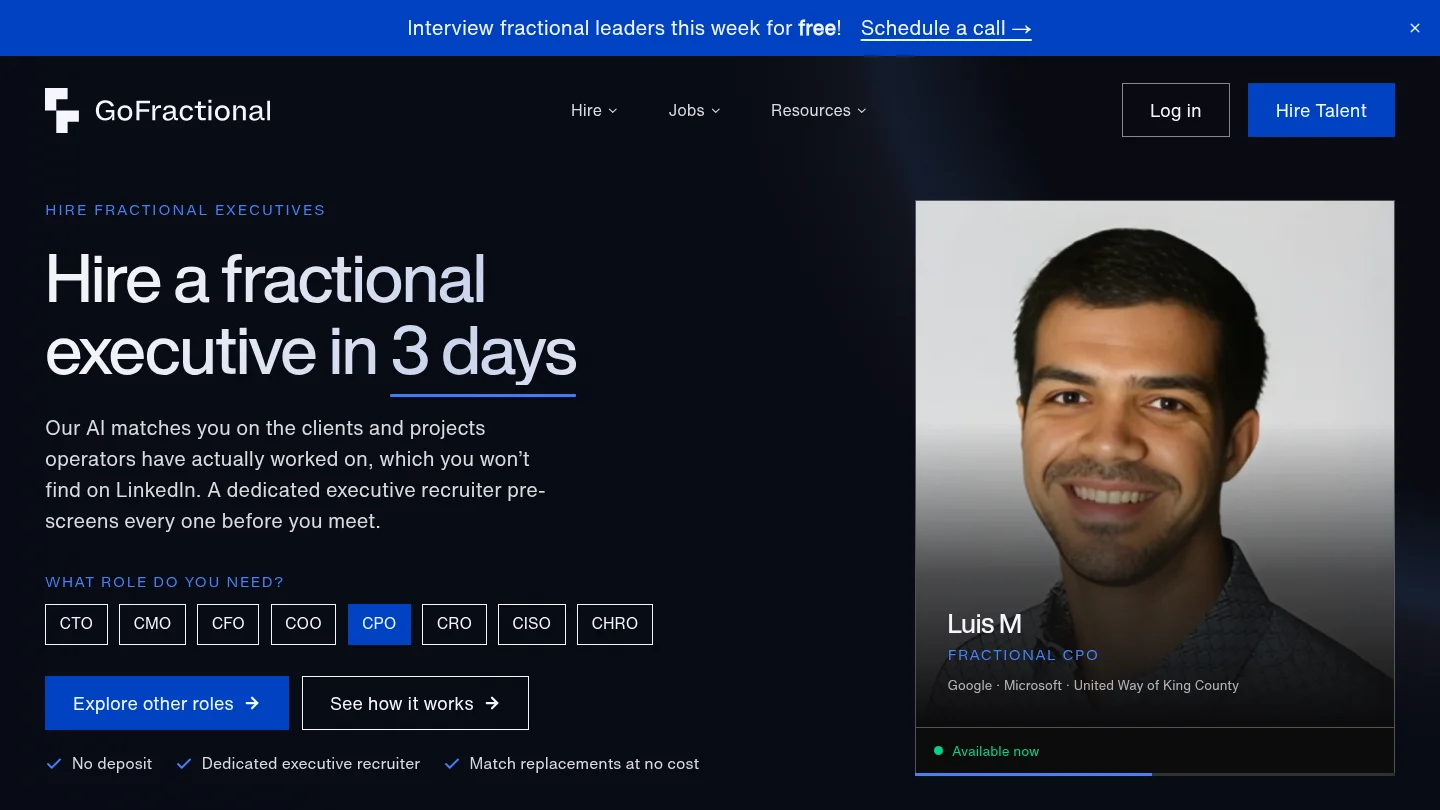
Best for: Companies seeking recruiter-supported matching with fractional or interim executives across multiple functions.
Go Fractional combines a talent platform with executive recruiter support. Its current materials describe AI-assisted matching from a network of operators, followed by recruiter screening. The company says that matched candidates are introduced in about three days.
This approach suits teams that want help with sourcing but still want to meet and choose from potential leaders. Define the executive’s authority and success measures before the match process, then check how the engagement will be managed after placement.
Pros
- Recruiter-supported matching may reduce the amount of sourcing work your team handles.
- The network covers multiple functions and both fractional and interim needs.
Cons
- Matching identifies candidates, but you still need to define the leader’s authority, outcomes, and operating rhythm.
- Confirm the current pricing and the terms for your chosen engagement model.
7. Fractional Jobs

Best for: Companies that want a curated search and prefer to contract directly with the fractional executive.
Fractional Jobs describes a search process that identifies candidates for a range of executive functions. After choosing a leader, the company hires and manages that person directly rather than keeping the engagement within a platform-mediated relationship.
That model gives your company control over the working relationship. It also means you should be ready to assess candidates, agree on a contract, and manage expectations and performance after the introduction.
Pros
- Direct hiring gives your company control of the executive relationship and engagement terms.
- The search covers multiple executive functions, making it useful when you have a defined role in mind.
Cons
- Your team owns the assessment, contracting, and day-to-day management after the match.
- Confirm the current search fee and terms before comparing the total cost with a managed firm.
8. Toptal
Best for: Businesses looking for flexible access to independent business, marketing, technology, or management talent.
Toptal is a broad talent network rather than a fractional-leadership-only firm. Its services include marketing experts, management consultants, finance specialists, and technology talent. The company describes flexible engagements and a screening process for its network.
This breadth can suit a defined project or a need that crosses several specialist areas. If you want someone to own an executive function over time, assess the individual’s leadership responsibilities and ongoing availability rather than relying on the network’s broad coverage alone.
Pros
- The wide range of talent categories suits projects that involve both business and technical expertise.
- Flexible engagements can help when you need a specialist or consultant for a defined scope.
Cons
- The broad talent model is not the same as a managed fractional executive engagement with defined ongoing ownership.
- You will need to verify that the selected professional has the leadership experience and availability your role requires.
9. Vendux

Best for: Companies that need fractional, interim, or project-based sales leadership.
Vendux focuses on matching businesses with sales leaders, including CROs, VPs of Sales, and sales directors. Its model is suited to commercial challenges such as a leadership gap, founder-led selling that needs to evolve, or a sales team that needs executive direction.
The firm describes a curated roster and matching process. Since its scope is sales-specific, confirm whether your main need is sales leadership or a broader go-to-market role that also covers marketing, operations, or another function.
Pros
- Its specialist focus fits companies with a clearly defined sales-leadership need.
- The firm describes options for fractional, interim, and project-based sales engagements.
Cons
- Its central focus is sales leadership, so it is not the right fit for a standalone finance, technology, or operations gap.
- Ask how much time the matched executive will commit and what responsibilities they will own.
Choose the model that fits your growth bottleneck
The right fractional leadership firm depends on the work your company needs owned. If you need senior judgment combined with practical implementation, Shadow Leaders is our strongest fit for post-PMF founders and scale-ups. If you need a specialist match, an interim leader, or sales-only support, shortlist a provider built around that model. Before committing, agree on the assigned leader, hours, decision rights, deliverables, and total monthly fee.
Contact us now so we can help you with your challenges and ambitions
If growth has stalled or decisions keep returning to you, consider whether experienced leadership could take ownership of a specific bottleneck. We work with founders and CEOs of post-PMF ventures, scale-ups, and fast-growing startups, with support shaped around your priorities.
Our work combines strategic guidance with tailored, hands-on implementation. You can access board advisors for up to 8 hours per week or fractional leaders for up to 32 hours per week. Our private collective includes more than 40 experts, and our stated average engagement range is €3,500 to €15,000 per advisor per month, depending on the advisor and hours. Explore our leadership services to see whether the model fits your goals.
Frequently Asked Questions
How is fractional leadership different from consulting?
A consultant usually advises on a defined question or project. A fractional leader works part-time within your organization, often taking ongoing responsibility for a function or leadership priority.
When should a scale-up hire a fractional leader?
Consider one when you need senior expertise and ongoing ownership, but the workload does not justify a full-time executive. Set the role’s priorities and authority before you begin.
What should a fractional leadership agreement define?
Agree on responsibilities, hours, decision rights, communication, deliverables, fee, and how progress will be reviewed. Also clarify who will handle implementation and how either side can end the engagement.
Can a matching platform provide hands-on implementation?
A match gives you access to a candidate, but it does not automatically establish who will carry out the work. Ask whether the provider manages delivery or whether your team will contract with and manage the leader directly.
How should international companies compare fractional firms?
Check the proposed leader’s experience with your markets, time zones, customers, and growth stage. Confirm availability, communication expectations, and the currency and terms of the engagement before you sign.